
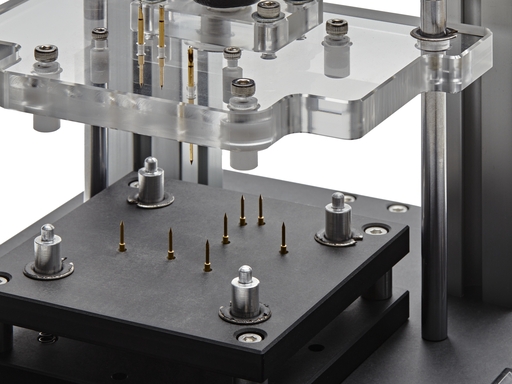
In modern electronic mass production, the stability of electrical testing is a core factor affecting product yield, rework cost, and overall manufacturing quality. Traditional manual point testing and flying-weld testing suffer from low efficiency, high human error, and irreversible board damage, which can no longer meet the high-precision, high-consistency, and high-volume production requirements of the electronics industry. As a standardized precision testing solution,pogo pin test fixtures deliver non-destructive elastic contact, fast electrical conduction, and long reusable service life. They have become essential standard tooling for R&D verification, batch inspection, and reliability testing of PCB boards, FPC flexible circuits, chip modules, and smart hardware devices.
Most manufacturing factories frequently encounter typical test issues including unstable test data, random false tests or missing tests, pad and substrate damage, and short fixture service cycles. In most cases, these problems are not caused by defective electronic products, but by unreasonable fixture selection, non-standard structural design, and irregular daily maintenance. This article summarizes industrial practical experience, sorts out the core working logic and structural characteristics of pogo pin test fixtures, and provides implementable selection, troubleshooting, and maintenance strategies for mass production scenarios.
1. Overview and Core Application Scenarios of Pogo Pin Test Fixtures
A pogo pin test fixture, also known as a pogo pin test jig or spring probe needle bed, is a dedicated precision clamping device that builds temporary stable electrical connection between the Device Under Test (DUT) and professional testing equipment through high-density spring probe arrays. With precise mechanical positioning and uniform elastic pressing design, the fixture supports automatic batch testing of circuit continuity, voltage, current, signal transmission, and product functional performance without manual alignment or soldering operation.
Compared with conventional testing methods, pogo pin test fixtures effectively solve common industrial pain points such as low testing efficiency, large manual deviation, and irreversible product damage. The mainstream application scenarios cover:
- ICT in-circuit testing and FCT functional testing for rigid PCBA assemblies
- Conductivity and performance testing for FPC flexible cables and ultra-thin flexible substrates
- Precision performance testing for chip modules and micro electronic components
- Long-term power-on aging testing and reliability verification for finished electronic products
- Batch quality inspection for semi-finished and finished products after SMT manufacturing processes
2. Working Principle of Pogo Pin Test Fixtures
The core functional unit of a pogo pin test fixture is the precision spring probe (pogo pin), which consists of three standard components: a movable plunger, a metal barrel, and a built-in compression spring, forming a vertically retractable elastic structure.
During the testing process, the fixture applies uniform vertical pressure to make the probe plunger closely contact the test pads, via holes, or functional contacts of the DUT. The probe contracts stably under pressure, and the constant spring force penetrates tiny oxide layers, dust, and oil stains on the contact surface, forming a low-impedance, high-stability electrical transmission channel.
The elastic contact mode fundamentally avoids rigid extrusion and hard scratching on PCB pads and FPC substrates. Qualified industrial testing relies on two key guarantees: stable and sufficient contact force to eliminate poor contact and test data drift; precisely controlled pressure range to prevent pad collapse and flexible substrate penetration. This is the key reason why pogo pin fixtures are widely adopted in standardized mass production testing.
3. Core Structural Composition of Mass-Production-Grade Pogo Pin Fixtures
A high-stability industrial pogo pin test fixture is not a simple combination of probes and plates. It is an integrated system composed of precision mechanical positioning structures and stable electrical signal transmission modules. The four core components work collaboratively to ensure long-term consistent testing accuracy:
3.1 Precision Probe Array (Core Conduction Unit)
Industrial-grade pogo pins are mostly manufactured with beryllium copper substrate and thick gold-plated surface treatment, featuring excellent oxidation resistance, corrosion resistance, ultra-low contact resistance, and high mechanical fatigue resistance. Multiple probe specifications are available for differentiated scenarios, including pointed tips, round tips, flat tips, and cup-shaped tips, with graded spring force from light force (30g–50g), standard force (60g–90g) to heavy force for high-load testing. Customized probe matching ensures reliable contact for different test points such as tiny pads, dense vias, and tin-rich solder points.
3.2 Anti-Static Positioning Base Plate
The fixture base plate is made of high-rigidity anti-static glass fiber board or high-precision acrylic material, with precise grooving and drilling according to DUT outlines and test point coordinates. It serves to fix the probe array and limit the placement position of electronic products, ensuring zero deviation of each loading position. This structure effectively avoids probe deflection, eccentric wear, and intermittent poor contact caused by positioning errors, guaranteeing consistent batch test data.
3.3 Press Driving Mechanism
Pogo pin test fixtures are divided into three driving types to match different production scales. Manual fixtures feature simple structure and low cost, suitable for laboratory R&D verification, sample testing, and small-batch trial production. Pneumatic and electric fixtures deliver high pressing parallelism and uniform pressure output, supporting 24-hour continuous operation, which is the mainstream solution for large-scale automated production lines.
3.4 Shielded Signal Switching Module
Composed of high-precision terminal blocks and shielded signal cables, this module uniformly transmits all electrical signals collected by the probe array to professional testing instruments and upper computer systems. It standardizes internal wiring, reduces external electromagnetic interference, and avoids signal distortion, virtual connection, and line falling-off, ensuring high accuracy for micro-current and high-frequency signal testing scenarios.
4. Scenario-Based Fixture Selection Guide (Industrial Standard)
There is no universal one-size-fits-all pogo pin test fixture. Scientific specification matching based on product characteristics and testing requirements is the premise of stable mass production. The industry’s most practical selection standards are summarized as follows:
4.1 Rigid PCBA Board Mass Production Testing
Applicable Scenarios: ICT in-circuit testing and FCT functional testing for motherboard rigid boards and hardware modules Recommended Solution: 60g–90g standard-force gold-plated round-tip probes Core Advantages: High universality, strong wear resistance, and stable contact performance, adapting to high-frequency repeated pressing in mass production.
4.2 FPC and Ultra-Thin Flexible Substrate Testing
Applicable Scenarios: FPC flexible flat cables, ultra-thin circuit substrates, and flexible film component testing Recommended Solution: 30g–50g light-force flat-tip probes Key Notes: Heavy-force pointed probes are strictly prohibited. Excessive pressure and sharp tips will easily scratch circuit traces and penetrate flexible substrates, causing permanent product scrapping.
4.3 Ultra-Fine Pitch Dense Pad Precision Testing
Applicable Scenarios: Chip pin testing, micro-dense pad arrays, and high-precision miniaturized module testing Recommended Solution: Custom ultra-fine precision probes Key Notes: Ordinary thick probes are prone to adjacent pin crosstalk and short-circuit risks, resulting in test misjudgment and abnormal yield fluctuation.
4.4 High-Current Long-Term Aging Testing
Applicable Scenarios: Continuous power-on aging test and long-term reliability verification Recommended Solution: Thickened gold-plated high-durability probes Key Notes: Ordinary probes will suffer from accelerated oxidation and rising contact resistance after long-term electrification, leading to large-area test failure in batch production.
5. Common Mass Production Test Problems and Professional Solutions
Based on mass production operation experience in electronic manufacturing factories, we sort out high-frequency test abnormalities of pogo pin fixtures, clarify root causes, and provide targeted solutions:
- Fluctuating Test Yield: Caused by probe surface dust, solder residue, oil contamination, and spring fatigue, leading to unstable contact resistance. Solution: Implement regular probe cleaning and timely replacement of aging probes.
- Intermittent Local Poor Contact: Caused by unbalanced pressing angle, inconsistent probe stroke, and DUT positioning deviation. Solution: Calibrate the fixture pressing parallelism and correct positioning accuracy regularly.
- FPC Substrate Damage: Caused by excessive probe spring force, sharp probe tips, and lack of buffer structure. Solution: Replace with light-force flat-tip probes and optimize fixture buffer pressing design.
- Rapid Fixture Performance Degradation: Caused by violent pressing, over-stroke operation, and insufficient daily inspection. Solution: Standardize operating specifications and conduct periodic calibration and maintenance.
- Inaccurate High-Frequency Signal Test Data: Caused by mismatched ordinary probes and unshielded messy wiring. Solution: Adopt dedicated high-frequency probes and standardize shielded wiring layout.
6. Standardized Maintenance Specification for Pogo Pin Test Fixtures
Scientific and standardized daily maintenance can effectively extend the service life of pogo pin fixtures, stabilize mass production yield, and reduce equipment replacement and rework costs. The universal industrial maintenance standards are as follows:
1. Regular Probe Cleaning: Gently wipe probe tips with dust-free cloth and anhydrous alcohol to remove solder residue, dust, and oil stains. Avoid scratching the gold-plated layer with hard tools, as coating damage will directly cause probe failure and unstable conduction.
2. Standard Pressing Operation: Forbid violent pressing and over-stroke operation. Standard operating procedures prevent spring fatigue, plunger deformation, and probe position offset, eliminating potential test abnormalities from the source.
3. Periodic Inspection and Calibration: Conduct weekly fixture inspection during mass production, including probe elasticity, alignment accuracy, and pressing parallelism. Replace deformed and aging probes in a timely manner and calibrate positioning structures to ensure long-term test stability.
4. Dust-Proof and Moisture-Proof Storage: Seal and store idle fixtures in dry, dust-free environments. Effective storage prevents probe oxidation, rust, and structural deformation, ensuring consistent accuracy for repeated use.
7. Conclusion
As indispensable basic tooling for electronic mass production testing, pogo pin test fixtures determine the accuracy, stability, and durability of the entire testing process, directly affecting manufacturing efficiency and product quality. Most abnormal test results in mass production are not caused by defective DUTs, but by unreasonable fixture selection, non-standard structural design, and inadequate daily maintenance.
Adopting scenario-based accurate selection, standardized operation processes, and periodic professional maintenance can maximize the performance of pogo pin test fixtures, effectively reduce test misjudgment rate and product scrap rate, and lower overall manufacturing and operation costs. For electronic manufacturing enterprises, standardized fixture management is a key low-cost and high-efficiency means to stabilize mass production quality and enhance market competitiveness.